“Ordinary individuals can make a meaningful difference in their communities by speaking up about issues they care about.” – Celiac Disease Foundation Advocate, Reagan Moore
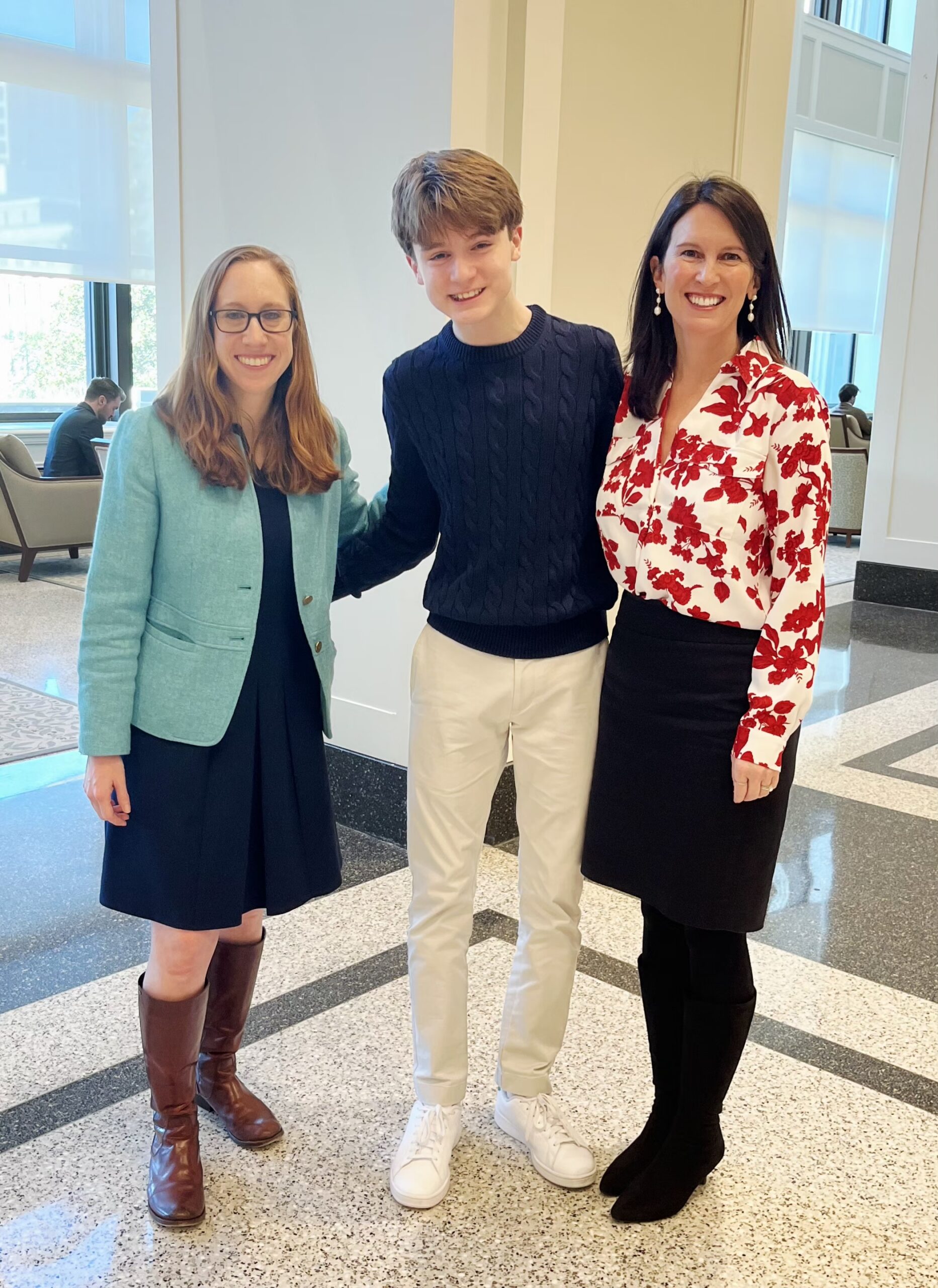
In 2026, updates to the Illinois Allergen Awareness Training Law added celiac disease to food allergen training requirements for certified food service managers. For many in the celiac disease community, the legislation represented an important moment of visibility for the everyday challenges of navigating the gluten-free diet. The progress in Illinois inspired individuals like Reagan Moore to advocate for celiac disease in their own communities.
Located in Virginia, Reagan saw firsthand the challenges her son Gabriel faced when dining out with celiac disease, particularly the lack of understanding about gluten exposure and cross-contact amongst restaurant staff. Motivated by Illinois’s legislation, Moore reached out to lawmakers in her community to help advance Virginia House Bill 380, legislation that adds celiac disease awareness and safety to the training materials provided to people working in restaurants.
Reagan’s advocacy journey is a powerful example of how individual voices can drive change. Her work reflects the growing need within the celiac disease community to increase public awareness of celiac disease and improve gluten-free dining safety nationwide. During the hearing for Virginia House Bill 380, Moore’s son, Gabriel Feitl, shared his experience living with both type 1 diabetes and silent celiac disease. Personal stories like Gabriel’s help connect policy to real-life challenges, demonstrating how patient and family advocacy can inspire meaningful legislative change. In the interview below, Moore shares her family’s experience navigating celiac disease, the inspiration she drew from Illinois’s landmark legislation, and what she learned throughout the process of advocating for celiac disease in Virginia.
Can you tell us a little about yourself and your connection to celiac disease?
My name is Reagan Moore. I am a senior program officer at the Institute of Museum and Library Services, an independent federal agency that provides grant support to the nation’s museums and libraries. I live in Alexandria, VA with my husband, Mark Feitl, and two sons, Sebastian and Gabriel. My connection to celiac disease is through my son, Gabriel. He was diagnosed with both type 1 diabetes and celiac disease in the spring of 2022. He is a “silent celiac,” which means that he is asymptomatic. We learned of his diagnosis through a screening performed while we were in the hospital for Gabriel’s diagnosis of type 1 diabetes. We are so glad the hospital screened Gabriel for other related autoimmune diseases because we would not have known about the damage happening to his small intestine.
When did you first feel that something needed to change in your state when it comes to gluten-free dining?
We first noticed something needed to change in gluten-free dining when we used the words “celiac disease” at a restaurant. We received many blank stares from servers. Many folks understand “gluten free,” but they think it is a dietary preference and don’t realize it’s a serious autoimmune disease. It is inaccurate to call it an allergen; however, we tried saying he had a gluten allergy just to get servers to understand the severity of his condition. On a number of occasions, we’ve ordered dishes from menus labeled as gluten-free, just to find out gluten was included. For instance, Gabriel ordered grilled squid from a local restaurant that labeled the appetizer gluten-free, but they included soy sauce on the dish that was not gluten-free. When I asked the server about the soy sauce, he immediately checked with the chef. The chef, admittedly, had never checked the ingredients of the soy sauce. Another time he ordered a gluten-free dish just to have the restaurant include garlic bread on top of it as a garnish. Many restaurant staff do not understand that simply removing the bread from the gluten-free food does not make the dish safe. They don’t understand cross contact and the harm that is still present. That is when I knew something needed to change. I genuinely think people in the restaurant industry want to provide great customer experience, but they need better training to understand the needs of patrons with celiac disease. And this is what VA House Bill does; it will require the Virginia Department of Health to develop new training resources for restaurant personnel focused on celiac disease. The updated resources will be posted in kitchens to make sure restaurant personnel understand celiac disease and specifically cross-contact.
Can you tell us how you went about this? Did you experience any hurdles or challenges while advocating for this Bill?
I reached out to my Virginia house delegate (now senator), Elizabeth Bennett-Parker. I worked with her and her staff in 2024 to pass legislation for Virginia House Bill 1039, which permits schools across Virginia to stock undesignated glucagon for students experiencing extremely low blood sugar. I testified on behalf of the bill twice. It passed and became law on July 1, 2024.
In 2025, I read an article about Illinois Senator Sally Turner’s celiac disease food safety legislation, SB1288, that became law. I thought, this is exactly what needs to happen in Virginia. I reached out to Bennett-Parker’s office again and they were immediately receptive to the idea. They worked with us on language for the bill and prepared us to provide testimony on behalf of it. For House Bill 380, I am particularly proud of Gabriel for standing up in front of the Health Subcommittee and providing testimony on his particular experiences with gluten-free dining.
One challenge in advocating for this bill was that Virginia’s laws and regulatory structure differ significantly from Illinois’s, so the Illinois approach could not simply be copied. In Illinois, existing law already required certified food sanitation managers to receive allergen-awareness training and specified the training content, making it straightforward to add celiac disease as another required topic.
In Virginia, however, the law only broadly requires restaurants to follow training standards related to food safety and food allergy awareness, while the detailed training requirements are contained in the Virginia administrative code and regulations. Because of this, we had to carefully determine where and how celiac disease language could legally be added. Instead of prescribing detailed training requirements in the bill itself, the legislation needed to focus on adding “including celiac disease” to the existing statutory language, while recognizing that the specifics of the training would ultimately need to be addressed through the administrative regulatory process.
What did this experience teach you about advocacy that you think others should know?
Over the past two years I’ve learned that advocacy is much more accessible than many people realize. I also learned that ordinary individuals, not just lawmakers and lobbyists, can make a meaningful difference in their communities by speaking up about issues they care about. Through this process, we realized change can start with people who are willing to share their experiences, stay persistent, and educate others. It’s meant a lot to me to have our boys be part of this process. They’ve both been to the Virginia General Assembly building, provided testimony (on behalf of both the 2024 House Bill 1039 and more recently House Bill 380), and witnessed firsthand what it takes for a bill to become a law. I want them to know that they can make change in the world around them.
Have an inspiring advocacy experience you’d like to share? Reach out to our advocacy team at advocacy@celiac.org to share your story.