“By sharing your experience authentically, you can help others recognize why change is needed.” – Aadya S.
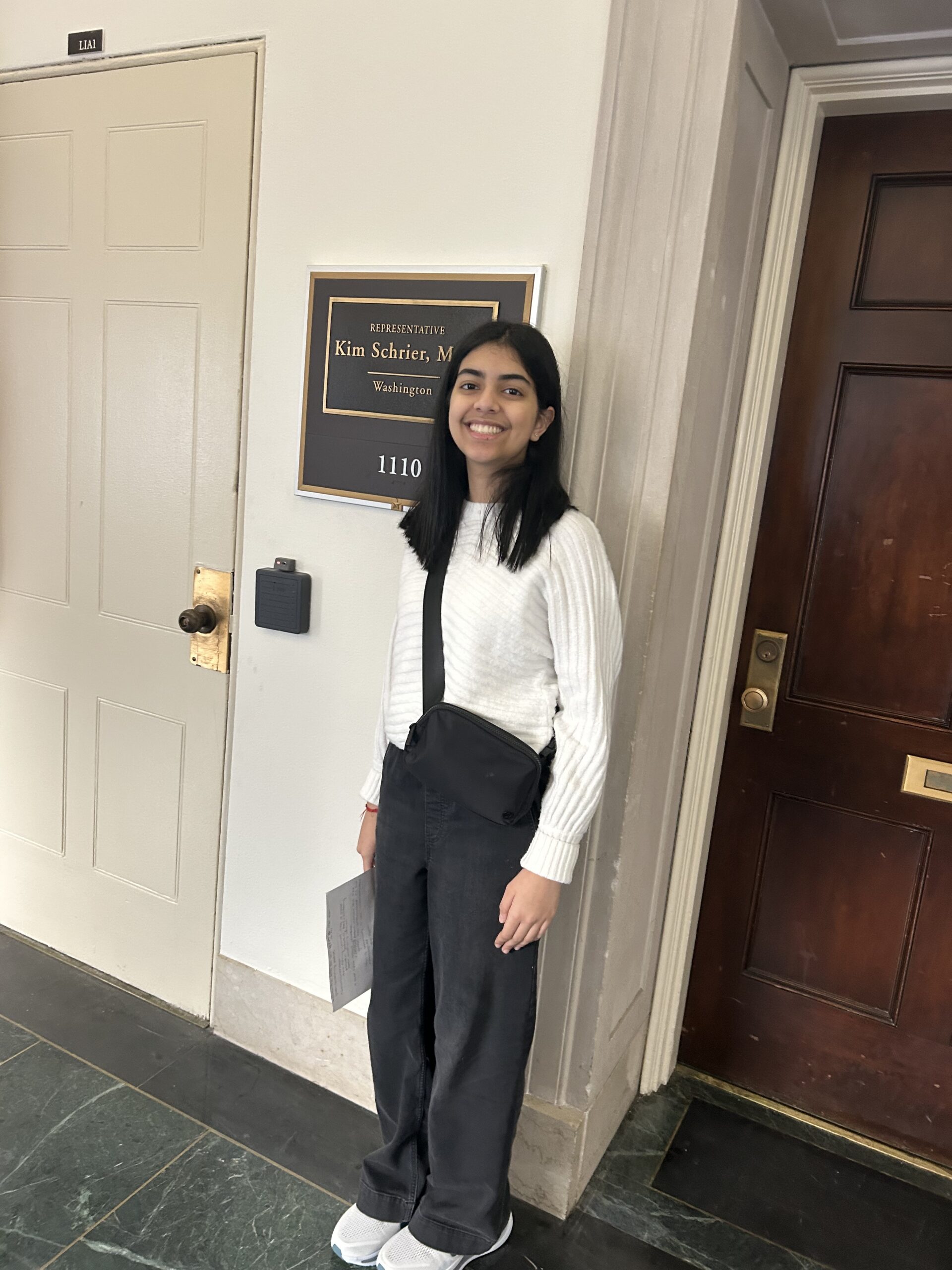 The Celiac Disease Foundation relies on the celiac disease community to use their voices to push for better policies and outcomes. This means everyone in the community can make a difference, and the voices of young people with celiac disease can be especially powerful. That is evident in one of our youth advocates, Aadya S.
Aadya is 16 years old from Sammamish, Washington, and was diagnosed with celiac disease at age five. From winning essay contests to attending our Advocacy Summit in Washington D.C., she has used her lived experience to advocate for policies that will improve outcomes for all people with celiac disease.
We sat down with Aadya to learn more about her experiences and what she believes others should know about the power of advocacy. Thank you, Aadya, for your continued advocacy!
Can you tell us about yourself and your connection to celiac disease?
My name is Aadya, and I was diagnosed with celiac disease when I was five years old. For most of my life, finding truly safe gluten-free food has been a constant challenge. At school and in public, celiac safe options are not always available or protected from cross-contamination. I have also seen how often celiac disease is misunderstood as a preference to eat gluten-free instead of a serious autoimmune condition. These experiences led me to join the [Seattle Children’s] Celiac Youth Leadership Council (CYLC). Through CYLC, I have been able to turn my own challenges into advocacy. I have collaborated with peers, helped lead projects, and spoken up about the need for greater awareness and safer access to food.
The Seattle Children’s Celiac Disease Program recently held an essay contest for children with celiac disease, and the prize was a trip to DC to participate in our Advocacy Summit and Hill Day. You won! What was your essay about?
For the contest, I wrote two essays. The first focused on the barriers people with celiac disease face when trying to find safe food at school and in public. I shared times when I was given unsafe food or told to simply “pick around” the gluten. I also wrote about skipping meals because going hungry sometimes felt safer than risking getting sick. I explained how gluten-free food can cost nearly twice as much as regular food, so for many families, safety comes down to what they can afford, not what they need to manage a medical condition. I closed by insisting that safe food is a basic human right, not a privilege, and that celiacs need mandatory cross-contamination training, equity in cost, and consistent enforcement of existing protections. My second essay focused on my experience working with elected leaders. I wrote about advocating at the local, state, and national levels. I discussed how my work in mental health had been recognized by the Mayor of Bremerton and my local representative. I also shared my experience testifying in support of HB 2225, a bill created to address the risks of AI companion chatbots. I explained that I hope to bring what I have learned from these experiences into my advocacy for the celiac community.
You also joined us for this year’s Celiac Disease Foundation Advocacy Summit and Hill Day. What was that experience like for you? Was there a particular meeting or moment that stood out to you?
The Advocacy Summit and Hill Day was an incredibly impactful experience because it gave me the opportunity to advocate directly with legislators and learn from families affected by celiac disease across the country. One of the most eye-opening parts was hearing how many people had gone undiagnosed for many decades before finally receiving answers. I also learned about families managing celiac disease alongside other autoimmune conditions such as Hashimoto’s disease and Type 1 diabetes. These experiences showed me how important greater awareness and earlier diagnosis truly are.
One meeting that especially stood out to me was our visit to a Washington State Representative office. We advocated for the Medical Nutrition Therapy Act and asked for greater support for the Congressional Celiac Disease Caucus. Her staff member also had celiac disease herself and was very interested in hearing about the concerns shared by advocates and families. That made the meeting feel especially meaningful because she understood many of the challenges on a personal level. It also showed me how powerful it can be to bring real experiences directly to legislators who are constantly making decisions that impact our health.
What did this experience teach you about advocacy that you think others should know?
One of the biggest things this experience taught me is that my voice truly matters. Before going to D.C., I did not realize how much legislators value hearing directly from the people affected by an issue. Sharing a personal experience can help them understand what celiac disease looks like beyond the statistics. I learned that meaningful advocacy comes from speaking honestly, even when it is difficult to share. You never know which part of your story may connect with someone or change how they understand an issue, and that is what makes real change possible. By sharing your experience authentically, you can help others recognize why change is needed.
What issues related to celiac disease are you most passionate about advocating for, and why?
I am most passionate about advocating for safer and more equal access to gluten-free food. Too often, people with celiac disease are given food that is labeled gluten-free but is still unsafe because of cross-contamination. I also care deeply about improving awareness, especially in schools, restaurants, and public spaces. Celiac disease is still often treated like a preference instead of a serious autoimmune condition. I would also like to see greater support for earlier diagnosis and more affordable gluten-free food. No one should have to choose between risking their health and going without food.
Have an inspiring advocacy experience you’d like to share? Reach out to our advocacy team at advocacy@celiac.org to share your story.