The Codex Committee on Food Labelling has approved international guidance for final adoption that strengthens risk-based “may contain” labeling for cereals containing gluten, while preserving the 20 ppm gluten-free standard.
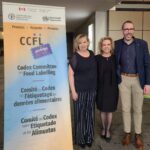
Melissa Secord (Celiac Canada), Marilyn Geller (Celiac Disease Foundation), Floris Van Overveld (AOECS)
At the 49th Session of the Codex Committee on Food Labelling (CCFL49), international food labeling experts forwarded for final adoption updated guidance for precautionary allergen labelling (PAL), which covers “may contain” statements on food labels. For the first time, there is a reference dose for cereals containing gluten, an important milestone for the celiac disease community, and one that the Celiac Disease Foundation worked over the last two years to make possible.
Previously, the only PAL guidance affecting celiac consumers applied to “may contain wheat” statements based on wheat allergy standards. This update recognizes that gluten cross-contact should be evaluated using science specific to celiac disease, accounting for total gluten exposure from wheat, barley, rye, and related grains combined and the long-term cumulative exposure risks unique to celiac disease. While the U.S. does not currently have a formal PAL framework for gluten, this update represents an important opportunity to help shape future U.S. labeling policy in alignment with evolving global standards, and one the Celiac Disease Foundation has been working toward for years.
Understanding the reference dose: The gluten reference dose is set at 4 mg. Importantly, this is not a new gluten-free threshold and it is not a consumer instruction. It is a scientific tool used in risk assessment. Foods labeled “gluten-free” must still contain less than 20 ppm gluten. The reference dose is used to calculate an action level – a food-specific level based on how much of that food someone would reasonably eat in a single eating occasion. A “may contain” statement should be used when risk assessment shows that unintended gluten presence from cereals containing gluten cannot be prevented or reduced to the action level.
That distinction matters. The goal is not more warning labels. The goal is better labels – labels that are meaningful, consistent, and based on risk. Clearer PAL guidance can help reduce vague facility or equipment statements such as “processed in a facility that also processes wheat” or “made on shared equipment with wheat,” because manufacturers have clearer guidance for when PAL is warranted and how it should appear. This is especially important for products labeled gluten-free, where ambiguous precautionary statements can undermine consumer confidence.
What This Means For The United States
The U.S. currently has no formal, regulated precautionary allergen labeling framework for gluten or for any allergen. U.S. consumers may see “may contain wheat” or vague facility and equipment statements, but there is not yet a broader science-based framework for communicating cross-contact risk in a way that reflects the needs of people with celiac disease
Important gaps also remain because wheat must be declared as a major allergen under U.S. law, while barley and rye are not subject to the same disclosure requirements. As a result, ingredients such as malt extract, malt syrup, brewer’s yeast, and barley-derived flavorings may not be immediately recognizable to consumers as sources of gluten.
The Foundation is working to bring the science from Codex, Food and Agriculture Organization (FAO), World Health Organization (WHO), International Society for the Study of Celiac Disease (ISSCD), and global partners into U.S. discussions with FDA. The Foundation continues to urge FDA to strengthen transparency around barley- and rye-derived ingredients and to ensure that any future precautionary labeling framework remains consistent with the gluten-free labeling rule and does not create contradictory signals for consumers.
The Celiac Disease Foundation has submitted formal comments to FDA urging the agency to incorporate gluten and celiac disease into its risk-based allergen threshold framework, and to adopt the 4 mg FAO/WHO reference dose as the basis for any precautionary labeling standard. The Foundation has also urged FDA to require declaration of barley- and rye-derived ingredients consistent with major allergen requirements for wheat.
The Foundation’s Role
The Celiac Disease Foundation helped build the pathway that made this progress possible. Since 2018, the Foundation has served as the North American representative to the Association of European Coeliac Societies (AOECS), strengthening the international relationships that supported this work. As Codex discussions on PAL advanced, the Foundation recognized the importance of ensuring that gluten remained within the PAL framework and that celiac disease required its own reference dose.
To raise this issue, the Foundation requested to attend the 48th Session of the Codex Committee on Food Labelling in Quebec City and was invited to join the U.S. delegation. At CCFL48, the Foundation helped elevate the need for gluten cross-contact to be evaluated through science-based risk assessment, rather than through wheat allergy standards that do not address the needs of people with celiac disease.
Following CCFL48, the Foundation asked the ISSCD to convene the Gluten Safety Standards Committee (GSSC), giving leading clinician-scientists a dedicated forum to address gluten safety, reference doses, cross-contact, and labeling frameworks. Foundation CEO Marilyn Geller has served as a member of the GSSC since its inception alongside AOECS Board Chair Floris van Overveld and international clinical and scientific experts. The Foundation also helped ensure that leading gluten and celiac disease experts participated in the FAO/WHO meeting that recommended the reference dose, and convened the Global Celiac Advocacy Alliance, a global coalition of celiac patient advocacy leaders working together to advance science-based advocacy on gluten safety, labeling, and cross-contact.
This is not the end of the process. International standards take time to influence national regulations, and FDA has its own rulemaking pathway. But this progress strengthens the scientific foundation for risk-based precautionary labeling for cereals containing gluten and reinforces confidence in the 20 ppm gluten-free standard.
With international guidance now forwarded for final adoption, the scientific foundation for risk-based gluten labeling has never been stronger. The Celiac Disease Foundation will continue working with scientific, regulatory, and advocacy partners to ensure that this progress shapes U.S. policy and that future labeling decisions are evidence-based, transparent, and truly protective of the millions of Americans living with celiac disease.